Label reading
Proprietary Blends Explained: How to Read a Label That Hides the Amounts
A proprietary blend is a group of ingredients listed under one total weight. U.S. rules require the total and an order from heaviest to lightest, but not each amount. Zeaxan uses one 600 mg blend of 11 ingredients, so nobody outside the maker can say how much lutein, zeaxanthin or ginkgo is in a serving.
Written by the Zeaxan editorial teamUpdated · 8 min read
The basics
What is a proprietary blend on a supplement label?
It is a set of ingredients grouped under one name and one total weight. The label lists what is inside but does not have to say how much of each (21 CFR 101.36).
You will see blends on many supplement labels. The word "proprietary" signals that the exact recipe stays with the company.
The law
What does the law require a blend label to show?
Two things: the blend's total weight, and its ingredients in descending order of predominance by weight. The federal rule, 21 CFR 101.36, does not require each ingredient's amount (21 CFR 101.36).
- Must show: the blend name and its total weight
- Must show: every ingredient, heaviest first
- Need not show: how much of each ingredient
FDA does not approve supplements before they are sold, and the company is responsible for safety (FDA, supplements). Nobody checks the hidden amounts for you before the bottle reaches a shelf.
A real example
What does a proprietary blend label look like?
This is the Zeaxan Supplement Facts panel, typed from the bottle. Tap a line to see what it means.
Supplement Facts
Serving Size: 2 Capsules · Servings Per Container: 30
One serving is two capsules. The bottle holds 60, so it lasts 30 days.
The total for all 11 ingredients together. No single amount is given, and no Daily Value is set.
Listed first. Blends list ingredients by weight, which suggests salt is the largest single ingredient.
No eye research. The label does not say which type of cinnamon.
Alpha-GPC, a choline compound usually sold for memory. One large study linked it to stroke risk; not proof.
A memory herb. The 20% describes how the extract is standardized, not its share of the capsule.
The AREDS2 eye formula used 10 mg a day. Here the amount is not published; 5% is the extract's strength.
Leaf, not berry. Rigorous trials did not find bilberry improves night vision.
Adults need 1.3-1.7 mg a day. The amount here is not published.
Ginkgo (the label spells it Gingko). It may raise bleeding risk with blood thinners.
Adults need 2.4 mcg a day. The 1% describes a diluted ingredient, not 1% of the capsule.
The product's namesake, listed 10th of 11. AREDS2 used 2 mg; this amount is not published.
Listed last. Green tea extract pills are a rare cause of liver injury.
Fillers and flow agents used in most capsules.
Typed from the bottle label. ** Daily Value not established. Blend order rule (21 CFR 101.36).
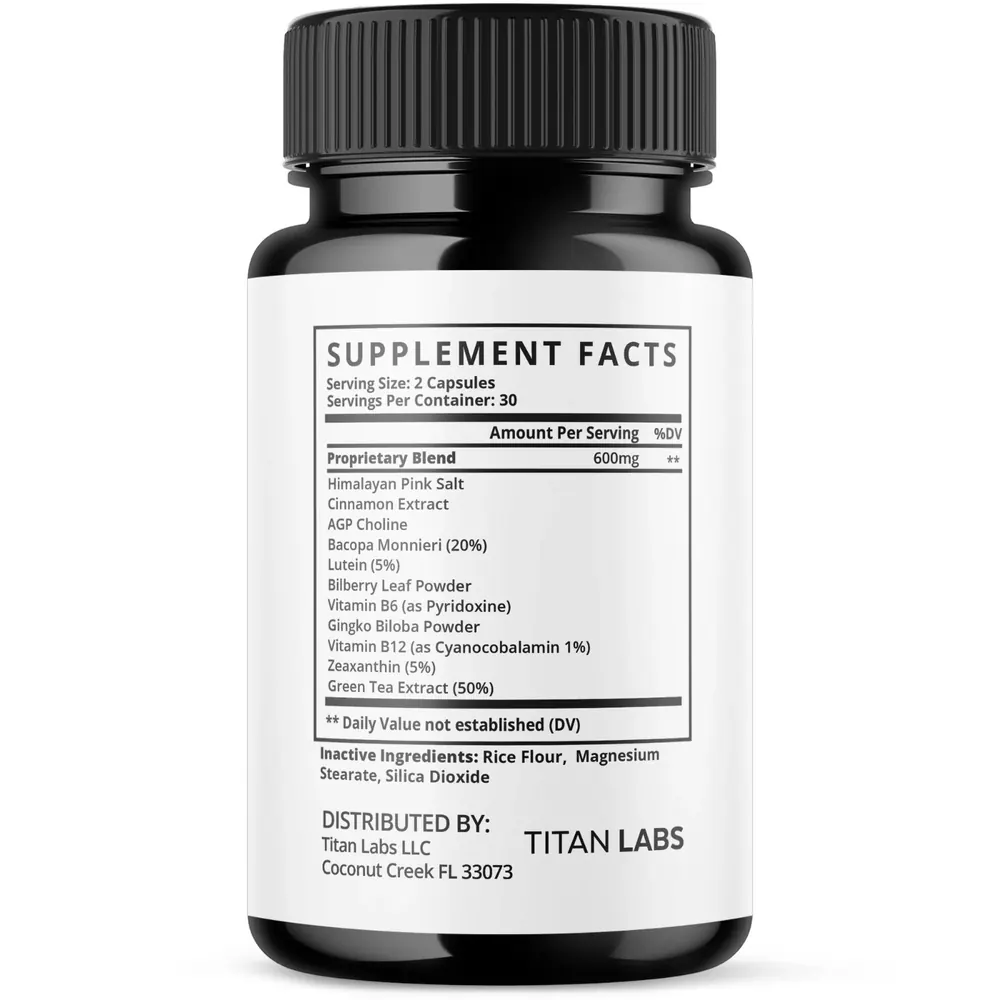
Tap a line of the panel to see what it means. The real label is beside it.
Do the math
What can the order of ingredients tell you?
It sets an upper limit, not an amount. An ingredient listed 5th can weigh no more than one-fifth of the blend, because the four before it each weigh at least as much.
| Ingredient (place) | Most it can weigh | What that means |
|---|---|---|
| Himalayan pink salt (1st) | Largest share | Listed first, which suggests it is the largest single ingredient |
| Lutein 5% (5th) | 600 mg / 5 = 120 mg of extract | At most about 6 mg of lutein; AREDS2 used 10 mg (NEI, AREDS2) |
| Gingko biloba (8th) | 600 mg / 8 = 75 mg | An upper limit only; the real amount is unknown |
| Zeaxanthin 5% (10th) | 600 mg / 10 = 60 mg of extract | At most about 3 mg of zeaxanthin; AREDS2 used 2 mg (NEI, AREDS2) |
The real numbers are likely much lower than these ceilings. See the full Zeaxan Supplement Facts and all eleven ingredients.
The small print
What does "5% lutein" mean on a label?
It describes the extract, not the capsule. "Lutein (5%)" usually means the extract is 5% lutein, so 100 mg of that extract holds about 5 mg of lutein.
The same goes for "Bacopa Monnieri (20%)" and "Green Tea Extract (50%)". Those labels do not even name which compound the percentage refers to. "Cyanocobalamin 1%" describes a diluted form of vitamin B12, not 1% of the capsule.
Try Zeaxan for 90 days2 capsules a day · 3 bottles per pack · today's price on the listing
See today's priceThe other side
Why do companies use proprietary blends?
The rule allows it, and a blend keeps the exact recipe private (21 CFR 101.36). The Zeaxan label gives no reason for using one.
Why it matters
Why does a blend make an eye supplement hard to judge?
Because research is done at specific doses. Without amounts, you cannot line a product up with a study, a daily need or a safety limit.
You cannot match lutein and zeaxanthin to AREDS2 (NEI, AREDS2). You cannot add up vitamin B6 across your supplements against the 100 mg upper limit (NIH ODS, B6). And your pharmacist cannot weigh the ginkgo against a blood thinner (NCCIH, ginkgo).
NCCIH adds that what is on a label may not be what is in the product (NCCIH, 2019). A blend gives you even less to check. Read what AREDS2 means for the doses that were studied.
Your checklist
What should you look for instead of a blend?
A label that prints each amount, matched to doses that were studied. Then look for a named lab or certifier.
An amount for every nutrient
Milligrams or micrograms next to each name, not one blend total.
Doses that match research
For AMD, the six AREDS2 amounts (NEI, AREDS2).
A named tester
Zeaxan's "Third Party Tested" badge names no lab. FDA facility registration is not approval (FDA, 2026).
Claims within the evidence
Health claims generally need randomized, controlled human trials (FTC, 2022).
More on badges and lot codes on our testing and quality page, and a full guide to choosing an eye supplement.
FAQ
Proprietary blend questions
What does proprietary blend mean on a supplement?
It means several ingredients are listed under one total weight, without each one's amount. U.S. rules require the total and an ingredient order from heaviest to lightest (21 CFR 101.36). You learn what is inside and the overall weight, but not how much of any single ingredient you take.
Are proprietary blends legal?
Yes. Federal labeling rules allow a blend as long as it shows its total weight and lists ingredients in order of weight (21 CFR 101.36). Legal is not the same as checked, though: FDA does not approve supplements before sale, and companies are responsible for their own safety (FDA, supplements).
What does it mean when salt is listed first in a supplement blend?
It suggests salt is the largest single ingredient, because blends list ingredients by weight, heaviest first (21 CFR 101.36). In Zeaxan, Himalayan pink salt comes before every eye nutrient. The whole blend is 600 mg, so the sodium is small next to the Daily Value of under 2,300 mg (FDA, sodium).
How can I find out the amounts in a proprietary blend?
Only the company knows them. The Zeaxan label prints its distributor, Titan Labs LLC of Coconut Creek, Florida, but no phone number, and no certificate of analysis is published. If exact doses matter to you, choose a product that prints them on the label.
Is a proprietary blend a red flag?
Not by itself, but it is a limit you should weigh. A blend means you cannot compare doses with research, daily needs or safety limits (NIH ODS, B6) (NEI, AREDS2). For an eye supplement aimed at AMD, a label with the full AREDS2 amounts is easier to judge.
What does standardized to 50% mean on an extract?
It means the extract has been made to contain a set share of one compound, here 50%. On Zeaxan's green tea extract, the label does not name that compound. The percentage describes the extract's strength, not its share of the capsule or of the 600 mg blend.
Is the 600 mg in Zeaxan the amount of each ingredient?
No. The 600 mg is the total for all 11 ingredients together in one 2-capsule serving. The inactive ingredients, rice flour, magnesium stearate and silica dioxide, are listed separately. No single ingredient's amount appears anywhere on the label (21 CFR 101.36).
Who wrote this
Written and reviewed by
Plain-language pages built from the bottle label and linked medical sources.
Last updated . Read our editorial standards and how we check reviews. This website is run by an authorized U.S. retailer, not by the manufacturer. We are paid a commission when you buy through our order links.
Keep reading
More about Zeaxan
Supplement Facts
The whole Zeaxan label typed out, with what each line means and what the label does not tell you.
Read moreIngredients
All 11 Zeaxan ingredients in label order, what each is for, and which ones call for a doctor's check.
Read more
Testing & quality
What the Third Party Tested, GMP and Made in the USA badges on Zeaxan prove, and what is still missing.
Read moreUSA authorized Zeaxan retailer
Ready to try Zeaxan?
The listing sells one 3-pack: 180 capsules, 90 days at 2 a day. Check today's price, delivery and return terms on the listing before you pay, and keep your eye exams.
- eBay Money Back Guarantee
- 30-day returns, as listed
- Free 2-4 day delivery, as listed